Toolkit Versioning
If you're building an agent, we recommend using sessions instead. Sessions handle toolkit versions automatically so you don't have to manage them yourself.
Toolkit versioning ensures your tools behave consistently across deployments. You can pin specific versions in production, test new releases in development, and roll back when needed.
To view available versions, go to Dashboard > All Toolkits > select a toolkit. The version dropdown shows the latest and all available versions:
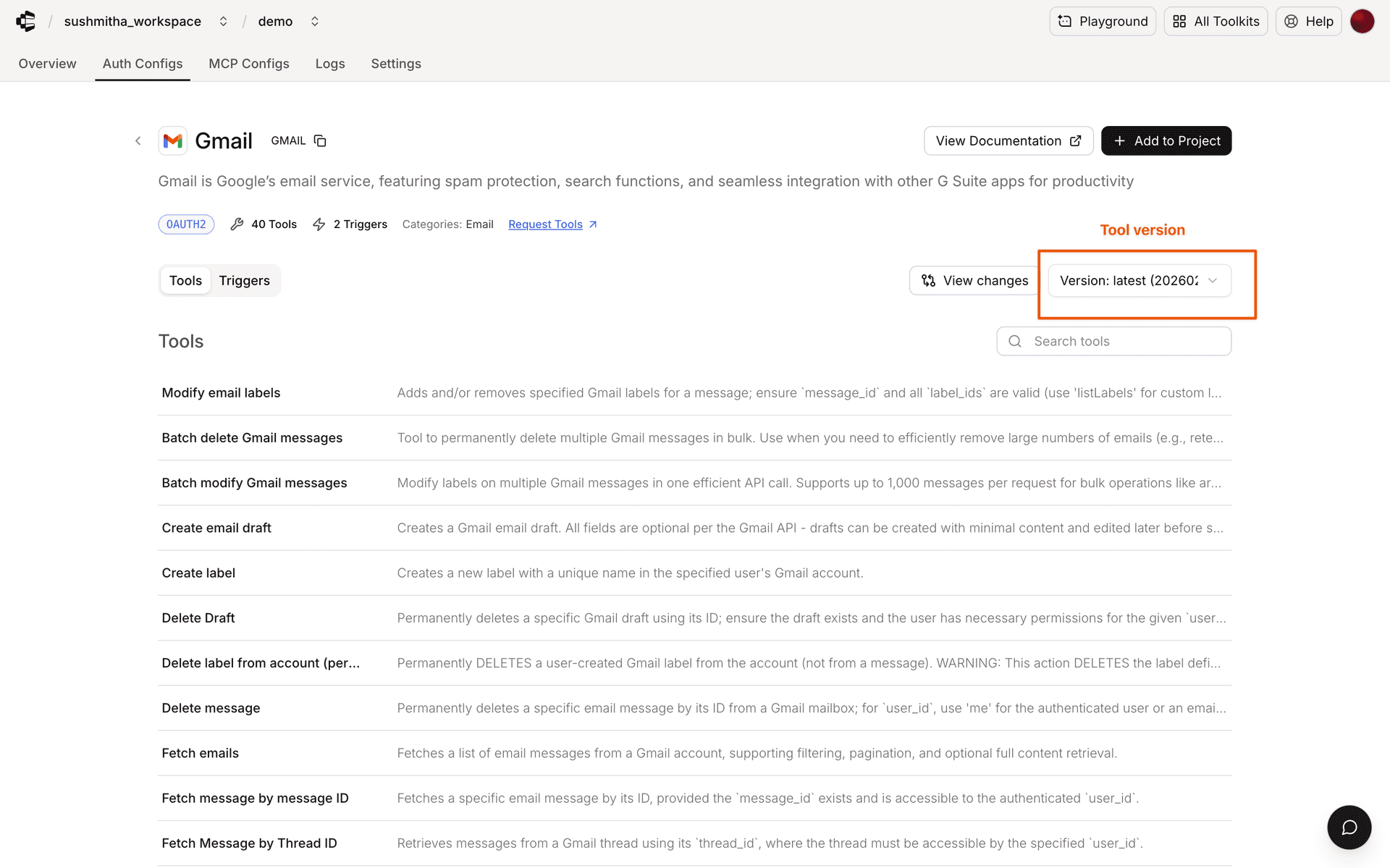
You can also find the latest version for each toolkit on the Toolkits page in the docs. Select a toolkit to see its current version and available tools.
Starting from Python SDK v0.9.0 and TypeScript SDK v0.2.0, specifying versions is required for manual tool execution.
Default version behavior
When no version is specified, the API defaults to the base version (00000000_00), not the latest version. This means the response may contain fewer tools than what's shown on the platform UI. To get all available tools including ones added in newer versions, explicitly set toolkit_versions to "latest" or a specific version.
This applies to both the SDK and direct REST API calls:
# Without version — returns only tools from the base version
curl 'https://backend.composio.dev/api/v3/tools?toolkit_slug=googledrive' \
  -H 'x-api-key: YOUR_API_KEY'

# With version=latest — returns all tools including newer ones
curl 'https://backend.composio.dev/api/v3/tools?toolkit_slug=googledrive&toolkit_versions=latest' \
  -H 'x-api-key: YOUR_API_KEY'
Configuration methods
Configure toolkit versions using one of three methods:
SDK initialization
from composio import Composio

# Pin specific versions for each toolkit
composio = Composio(
    api_key="YOUR_API_KEY",
    toolkit_versions={
        "github": "20251027_00",
        "slack": "20251027_00",
        "gmail": "20251027_00"
    }
)
import { Composio } from "@composio/core";
// Pin specific versions for each toolkit
const composio = new Composio({
apiKey: "YOUR_API_KEY",
toolkitVersions: {
github: "20251027_00",
slack: "20251027_00",
gmail: "20251027_00"
}
});Environment variables
# Set versions for specific toolkits
export COMPOSIO_TOOLKIT_VERSION_GITHUB="20251027_00"
export COMPOSIO_TOOLKIT_VERSION_SLACK="20251027_00"
export COMPOSIO_TOOLKIT_VERSION_GMAIL="20251027_00"
Per-execution override
from composio import Composio

composio = Composio(api_key="YOUR_API_KEY")

# Specify version directly in execute call
result = composio.tools.execute(
    "GITHUB_LIST_STARGAZERS",
    arguments={
        "owner": "ComposioHQ",
        "repo": "composio"
    },
    user_id="user-k7334",
    version="20251027_00"  # Override version for this execution
)
print(result)
import { Composio } from "@composio/core";
const composio = new Composio({ apiKey: "YOUR_API_KEY" });
// Specify version directly in execute call
const result = await composio.tools.execute("GITHUB_LIST_STARGAZERS", {
userId: "user-k7334",
arguments: {
owner: "ComposioHQ",
repo: "composio"
},
version: "20251027_00" // Override version for this execution
});
console.log(result);Version format
Versions follow the format YYYYMMDD_NN:
YYYYMMDD: Release dateNN: Sequential release number
# Production — pin to a specific version
toolkit_versions = {"github": "20251027_00"}

# Development — always use the newest tools
toolkit_versions = {"github": "latest"}
Never use latest in production. It can introduce breaking changes. Pin to a specific version instead.
Version resolution order
- Per-execution version (highest priority)
- SDK initialization version
- Environment variable (toolkit-specific)
Managing versions
Check available versions using:
# Get toolkit information including available versions
toolkit = composio.toolkits.get(slug="github")

# Extract and print version information
print(f"Toolkit: {toolkit.name}")
print(f"Current Version: {toolkit.meta.version}")
print(f"Available Versions: {toolkit.meta.available_versions}")
// Get toolkit information including available versions
const toolkit = await composio.toolkits.get("github");
// Extract and print version information
console.log("Toolkit:", toolkit.name);
console.log("Available Versions:", toolkit.meta.availableVersions);
console.log("Latest Version:", toolkit.meta.availableVersions?.[0]);Third-party integrations
If you're using Composio through a third-party platform (e.g., MindPal, n8n, Make, or other automation tools), tool visibility depends on how the platform fetches tools from the Composio API.
The Composio SDK defaults to toolkit_versions="latest", so all tools are returned automatically. However, platforms that call the REST API directly without specifying toolkit_versions will only see base-version tools, which may be a subset of the full toolkit.
If you're seeing fewer tools than expected in a third-party integration:
- Check the platform's Composio configuration — look for a "toolkit version" or "API version" setting and set it to
latestor a specific version. - If the platform doesn't expose this setting, contact the platform's support and ask them to pass
toolkit_versions=latest(or a pinned version) when calling the Composio tools API. - As a workaround, you can call tools by slug directly even if they don't appear in the tool list — tool execution doesn't require the tool to be in the listing response.
# REST API — list all tools for a toolkit (including newer versions)
curl 'https://backend.composio.dev/api/v3/tools?toolkit_slug=gladia&toolkit_versions=latest' \
  -H 'x-api-key: YOUR_API_KEY'
Troubleshooting
I see fewer tools than expected
When no toolkit_versions parameter is specified, the REST API defaults to the base version (00000000_00). Tools added in newer versions won't appear in the response.
Fix: Pass toolkit_versions=latest or a specific version string (e.g., 20260310_00) when listing tools.
The dashboard shows more tools than the API returns
The Composio dashboard always shows the latest version of each toolkit. The API defaults to the base version for stability. Pass toolkit_versions=latest to match what the dashboard shows.
SDK returns all tools but REST API doesn't
The Composio SDK (Python and TypeScript) defaults to toolkit_versions="latest" since SDK v0.9.0 (Python) and v0.2.0 (TypeScript). Direct REST API calls default to the base version. Add toolkit_versions=latest to your API query parameters to get the same results.